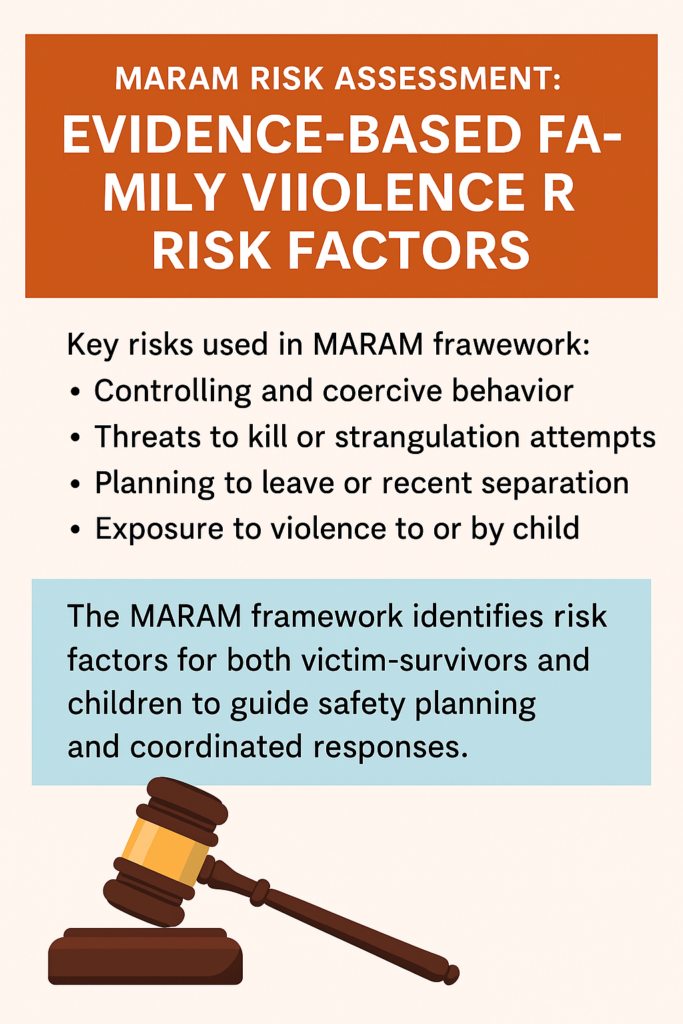
In Victoria, a MARAM risk assessment is the key tool used to identify and respond to family violence risk for adults and children. It gives professionals a shared language and clear framework so they can recognise danger early, plan for safety, and keep perpetrators in view and accountable. Victorian Government+1
What Is a MARAM Risk Assessment?
A MARAM risk assessment sits within the Family Violence Multi-Agency Risk Assessment and Management Framework (MARAM). This framework is established under the Family Violence Protection Act 2008 (Vic) and is used across services such as police, courts, health, education, housing and specialist family violence services. Victorian Government+1
The aim of MARAM is to:
- increase the safety and wellbeing of victim survivors
- support services to identify, assess and manage family violence risk
- ensure perpetrators are kept in view and held accountable for their behaviour. Victorian Government+1
A MARAM risk assessment brings together information about the perpetrator’s behaviour, the victim survivor’s circumstances, and any risks or vulnerabilities affecting children.
Key Evidence-Based Risk Factors in a MARAM Risk Assessment
The MARAM Practice Guides set out a list of evidence-based family violence risk factors. These are drawn from international research and expert consultation and are grouped into several categories. Victorian Government+1
1. Perpetrator Behaviours
A MARAM risk assessment looks closely at the perpetrator’s actions, including:
- Controlling and coercive behaviours
- Access to, or use of, weapons
- Threats to kill the victim or others
- Threats or attempts to strangle or choke
- Stalking (in person or via technology)
- Sexual assault
- Breaches of intervention orders or court orders
- Obsession or jealous behaviour
- Drug or alcohol misuse combined with other risk factors
Some of these are identified as serious risk factors because they are linked to an increased risk of the victim being killed or almost killed. Victorian Government
2. Adult Victim Survivor Circumstances
The MARAM framework also looks at the context of an adult victim’s life, such as:
- Physical assault during pregnancy or following birth
- Planning to leave or recent separation
- Escalation in severity or frequency of violence
- Financial abuse and financial hardship
- The victim’s own assessment of risk and fear
When a MARAM risk assessment shows multiple risk factors together, the overall level of danger can increase significantly.
3. Risk Factors for Children
Children are recognised as victim survivors in their own right. A MARAM risk assessment identifies child-specific factors such as:
- Exposure to family violence, even if they don’t see every incident
- Child intervention in the violence (trying to protect a parent)
- Sexualised behaviours towards the child by the perpetrator
- Threats to abduct or not return the child
- Undermining the child–parent relationship
Children may also show changes in behaviour—like withdrawal, anxiety or aggression—that cannot be explained by other causes and may indicate increasing risk at home. Gippsland Family Violence Alliance+1
How MARAM Risk Assessment Supports Safer Responses
Because MARAM is used across the Victorian service system, a MARAM risk assessment helps different workers to:
- share a common understanding of risk
- make consistent decisions about the level of danger
- coordinate responses and safety plans across services
- keep perpetrators in view rather than placing responsibility on the victim survivor alone. Victorian Government+1
For many agencies, the risk assessment tools are built into their client management systems, making it easier to record and update changes in risk over time.
Internal & External Resources
If you are seeking legal advice about intervention orders or family violence matters, you can contact
<a href=”https://domesticfamilyviolencelawyers.au/”>Domestic Family Violence Lawyers</a> for tailored guidance about your options and next steps.
For more detailed information about the Victorian framework, visit the
<a href=”https://www.vic.gov.au/maram-practice-guides-and-resources” target=”_blank” rel=”noopener noreferrer”>MARAM practice guides and resources on the Victorian Government website</a>. Victorian Government
When to Seek Help and Legal Advice About Family Violence
If any of the MARAM risk assessment factors described above sound familiar—whether for you, a child, or someone you support—it is important to seek help as soon as it is safe to do so. You may need:
- a safety plan
- support from a specialist family violence service
- legal advice about family violence and intervention orders